

Building simulation games have transformed from simple pixel-based tycoons into complex, creatively demanding experiences that rival traditional sandbox games in depth and engagement. Whether you’re dreaming up a sprawling metropolis in Cities: Skylines, managing the intricate logistics of a space station, or carefully orchestrating every detail of a theme park, building sims offer a unique blend of creative freedom and strategic challenge. The genre has exploded in recent years, attracting everyone from hardcore strategy fans to casual players seeking a more contemplative gaming experience. If you’re interested in diving into building simulation games, or mastering the ones you’re already playing, this guide covers everything you need to know about the genre, from its origins to the best titles available across all platforms in 2026.
Key Takeaways
- Building simulation games combine creative freedom with strategic complexity, allowing players to design cities, factories, and parks while managing interconnected systems and resources.
- Modern building simulation games have evolved from simple 2D grids to immersive 3D environments with sophisticated AI, larger maps, and robust modding communities that extend gameplay indefinitely.
- Top titles like Cities: Skylines II, Factorio, Planet Coaster, and Manor Lords cater to different interests, from urban planning and factory optimization to amusement park design and historical city-building.
- Success in building sims requires avoiding common pitfalls like overexpansion, ignoring infrastructure growth, and perfectionism paralysis—instead, focus on steady specialization, system planning, and iterative improvement.
- Building simulation games appeal beyond gamers to architects, engineers, students, and professionals seeking creative outlets and educational value, while providing stress-relief through constructive, consequence-free play.
- The future of building sims points toward larger simulations, hybrid genres blending building with roguelike and narrative mechanics, multiplayer collaboration, and the blurring of game and creative tool boundaries.
What Are Building Simulation Games?
Building simulation games are strategy-focused titles that task players with constructing, managing, and expanding virtual worlds. Unlike action games, the core appeal lies in planning, resource allocation, and watching your designs come to life rather than moment-to-moment reflexes. These games span multiple subgenres: city builders focus on urban planning and infrastructure, tycoon games emphasize business management and profit, construction sims let you build from the ground up, and sandbox titles blend creation with survival or exploration elements.
The fundamental loop in most building sims is straightforward but deeply satisfying. You gather or earn resources, plan layouts for buildings or infrastructure, place structures according to zoning or gameplay rules, and manage the consequences of those placements, whether that’s traffic flow, pollution, citizen happiness, or profitability. What makes the genre compelling is the complexity hiding beneath that simple loop. Every decision cascades. A poorly placed power plant affects residential zoning. An inefficient road network strangles your economy. A misaligned water treatment facility creates environmental disasters.
Building sims demand both creative vision and analytical thinking. You’ll sketch out blueprints mentally, optimize supply chains, troubleshoot problems, and iterate on designs. It’s architectural thinking meets puzzle-solving, which explains why the genre appeals across demographics, from architects and engineers looking for creative outlets to casual players who just want to build something cool without real-world consequences.
The Evolution of Building Sims: From Pixels to Photo-Realistic Worlds
Building simulation games have come a long way from their humble 2D beginnings. The journey from simplistic grid-based construction to immersive 3D cities showcases how technological advances have shaped the genre’s possibilities and player expectations.
Early Classics That Defined the Genre
SimCity (1989) is the game that essentially invented the city builder. Will Wright’s masterpiece gave players a grid, zoning tools, and systems to manage, and players immediately fell in love with the idea of playing god in a virtual metropolis. The mechanics were revolutionary for the time: you’d zone residential, commercial, and industrial areas, build infrastructure, and watch emergent behavior unfold as your city grew. The original and SimCity 2000 (1993) established the template that most city builders still follow today.
Theme Park (1994) and RollerCoaster Tycoon (1999) brought similar construction concepts into more specialized domains. Theme Park let you design amusement facilities: RollerCoaster Tycoon elevated the formula with incredible depth, allowing obsessive optimization of every coaster angle, queue length, and park detail. These classics proved that building sims could thrive in different settings as long as the core loop felt rewarding.
The 1990s and early 2000s saw a golden era for the genre. Transport Tycoon (1994) added complexity through logistics and economics. SimCity 3000 and 4 refined urban planning further. The Sims (2000) blended building with life simulation. Each iteration added depth without losing accessibility, and these games still influence modern building sims.
Modern Innovations and Technological Advances
The jump from 2D isometric grids to full 3D environments completely transformed what building sims could offer. Cities: Skylines (2015) became the modern gold standard for city builders, dumping the SimCity franchise’s DRM troubles and complex systems in favor of elegant, accessible design backed by serious simulation depth. Suddenly, players could rotate their cameras, zoom into individual neighborhoods, and see their city’s infrastructure in gorgeous detail.
3D environments enabled new possibilities: seeing traffic flow in real-time, understanding sight lines and aesthetics, and appreciating the tangible world you’d built. Games like Planet Coaster (2016) and Planet Zoo (2019) leveraged 3D to create immersive management experiences where players design coaster layouts in three-dimensional space and observe guest behavior from multiple camera angles.
Modern building sims also benefit from better technology in other ways. Larger maps can exist without crushing performance. More complex simulations run smoothly, tracking thousands of individual units, vehicles, or citizens. Modding tools have become more sophisticated, allowing community-created content that extends game lifespans indefinitely. Visual fidelity has reached points where screenshots of cities or parks look genuinely impressive.
Recent years have also seen genre evolution beyond traditional city builders. Games like Spiritfarer blend building and crafting with emotional narrative. Manor Lords (Early Access, moving toward 2026 release) brings medieval city-building aesthetics. Against the Storm focuses on roguelike building mechanics. The genre continues expanding, proving building sims aren’t a stagnant category relying on the same formula repeatedly.
Top Building Simulation Games to Play Right Now
Whether you’re shopping for your next gaming obsession or looking to expand beyond your current favorites, here’s a breakdown of the best building sims available across platforms in 2026.
Best PC Building Sims
Cities: Skylines remains the undisputed king of PC city builders. The 2015 original is still phenomenal, though the recently released Cities: Skylines II (2023) offers updated graphics, improved traffic simulation, and expanded mechanics. II is more demanding hardware-wise but features richer visuals and more sophisticated city simulation. The modding community is enormous for both versions, extending playability indefinitely.
Planet Coaster and Planet Zoo form a spiritual successor to RollerCoaster Tycoon. Planet Coaster (2016) lets you design elaborate amusement parks with coaster-building depth, precision matters for track banking, supports, and guest satisfaction. Planet Zoo (2019) applies the same philosophy to wildlife management, with conservation and breeding mechanics alongside park design. Both games scratch different itches while sharing design DNA.
Factorio is a factory-building sim that’s deceptively addictive. You’re stranded on an alien planet and must build an ever-expanding factory to produce rockets and escape. It sounds simple until you’re optimizing assembly lines, managing logistics networks, and defending against hostile creatures. The early-access rhythm of regular updates keeps the community engaged, and the base game is feature-complete even before official 1.0 release.
Manor Lords is generating serious buzz as a medieval city-builder. It’s in early access but demonstrating real promise with gorgeous visuals, period-appropriate building types, and agricultural focus. As building sims focused on ancient Rome or historical periods have gained interest, Manor Lords capitalizes on that appetite for something different from modern cities.
Against the Storm inverts typical city-building with roguelike elements. Each run, you’re dropped into a procedurally generated map to build a settlement before the rains force you out. It’s perfect for players who find typical building sims feel endless or overwhelming, structured runs with clear goals keep pacing tight.
Console Options for Console Gamers
Console players have fewer options, but the quality is strong. Cities: Skylines came to PS4, Xbox One, and Nintendo Switch, bringing the city-building experience to living room TVs. Performance varies on Switch (it’s the most scaled-back version), but the game remains fully playable on all platforms. Xbox Series X/S and PS5 versions run significantly better, though they’re essentially enhanced ports rather than new experiences.
Spiritfarer (2020, available on Switch, PS4, Xbox) is a gem if you want building mechanics with emotional weight. It’s technically about ferrying spirits to the afterlife, but the core loop involves building and managing your ferry with workstations, gathering materials, and crafting. The narrative is heartfelt without being saccharine, making it resonate differently than typical management sims.
Grounded (Early Access, moving toward full release in 2026) incorporates base-building as a core mechanic alongside exploration and survival. You’re honey-bee-sized survivors in a backyard, building shelter and defenses while investigating the mystery of your situation. It’s not a pure building sim, but the construction elements are substantial enough to appeal to the genre’s fans.
Console players hoping for ports of hits like Factorio or more recent city-builders should keep watching. The gap between PC and console building sim availability reflects design complexity and control scheme adaptability, though that gap is gradually narrowing.
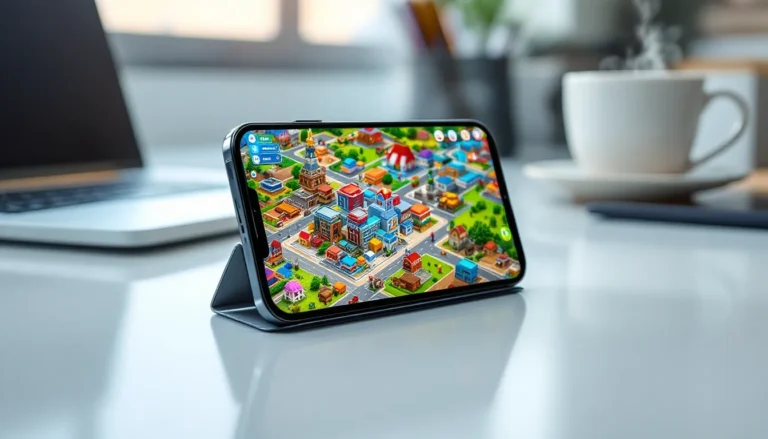
Mobile Building Games Worth Your Time
Mobile building games are exploding. Thrive: Survival Evolved is a evolution simulator where players build organisms from cells upward, progressing through increasingly complex life forms. It’s free-to-play without aggressive monetization, surprising for mobile.
Two Point Hospital and Two Point Campus brought the management sim tradition to mobile while maintaining the charm and depth of the originals. Two Point Hospital (Hospital sim) and Two Point Campus (university management) both came to mobile after PC success, with adjusted UI for touchscreen and optional cloud saves to sync between devices.
SimCity BuildIt is the modern mobile SimCity experience. It’s free-to-play with some monetization friction, but the core gameplay loop of building a city works on mobile, and events keep players engaged. It’s not as simulation-heavy as PC versions, but it scratches the city-building itch during commutes.
Minecraft deserves mention as a pure building sandbox without management mechanics. If you want absolute creative freedom without resource tracking or systems to manage, Minecraft is the gold standard. Survival Mode adds tension and goals: Creative Mode removes all restrictions. It’s fundamental building game design.
Mobile building games tend to lean toward casual appeal with lighter mechanics and shorter play sessions, but quality titles prove the genre works across all platforms when designed thoughtfully for the platform’s strengths.
Essential Tips for Mastering Building Simulation Games
Becoming proficient at building sims requires understanding systems and developing strategic thinking. Here’s how to optimize your approach and avoid the pitfalls that derail new players.
Resource Management Strategies
In any building sim, resources are the currency of progress. Whether it’s cash, materials, energy, or population, scarcity drives decision-making. The first principle: don’t rush expansion. New players typically overextend early, building infrastructure they can’t afford to maintain. Start small, generate revenue or resources, then expand methodically.
Second, specialize before diversifying. In Cities: Skylines, don’t try to be everything at once. Focus on a successful residential zone, optimize traffic, then add commercial, each step compounding on the last. In tycoon games, fully develop one revenue stream before adding others. Specialization lets you understand systems deeply rather than juggling incomplete ideas.
Third, maintain buffers. Don’t run economies at 100% capacity. Budget surplus means you can handle emergencies, a fire outbreak in Cities, a ride closure in Planet Coaster, without cascading failure. Games often punish complacency, and margins for error expand when you’re not operating at knife’s edge efficiency.
Fourth, automate what’s repeatable. Many modern building sims let you set up systems that run passively. In Factorio, well-designed production lines produce indefinitely. In Spiritfarer, established work stations generate resources automatically. Understanding what can run unattended frees mental energy for strategic decisions.
Planning and Design Best Practices
Successful building requires looking before you leap. Sketch layouts mentally before placing structures. In city builders, understand zoning rules, traffic patterns, and service coverage before building dense neighborhoods. Placing residential next to industrial is convenient for employment but creates pollution problems. Planning prevents costly demolition.
Second, think in systems. Every structure has inputs and outputs. A coal plant generates power but creates pollution. A school serves education but requires students within range. Map these connections before building: where does water come from and go? How’s waste handled? What’s the traffic impact? Systems thinking prevents isolated structures that fail to integrate.
Third, aesthetic planning matters more than it seems. Games like Cities: Skylines score based on city beauty and citizen happiness alongside pure economic efficiency. Parks increase desirability. Tree-lined roads attract wealthier residents. In Planet Coaster, guest satisfaction multiplies revenue. Integrating beauty into planning, not as afterthought, makes systems more efficient.
Fourth, leave room for changes. Don’t fill every tile immediately. A few empty blocks provide buffer space for infrastructure adjustments or emergency services. In real planning, flexibility is professionalism: the same applies in games.
Common Mistakes to Avoid
Most building sim failures follow predictable patterns. Mistake one: ignoring infrastructure growth. Players build dense residential areas but forget roads scale poorly, create gridlock before ever addressing it. Plan road networks early, hierarchically (highways carry volume, streets handle distribution), and anticipate growth.
Mistake two: not understanding service radius. Schools, hospitals, fire stations, police all have limited range. You’ll build redundant services in some areas while leaving others uncovered. Paying attention to coverage prevents inefficiency. Many games show service radius overlays, use them.
Mistake three: neglecting early foundation. A weak early economy or poorly planned layout compounds across an entire playthrough. Games rarely let you rebuild efficiently once sprawl sets in. Invest time in early planning: mistakes now become permanent problems later.
Mistake four: ignoring feedback systems. Games provide tools, budget breakdowns, citizen complaints, performance metrics. PC Gamer’s reviews of building sims frequently highlight how reading game feedback prevents costly missteps. Pay attention to what’s failing before it becomes catastrophic.
Mistake five: perfectionism paralysis. Some players optimize endlessly, never advancing. Building sims reward iteration, not perfection. Make decisions, see results, adjust. Imperfect progress beats perfect planning that never launches.
Why Building Sims Appeal to Gamers and Non-Gamers Alike
Building simulation games transcend traditional gaming demographics. Understanding why reveals what the genre does uniquely well.
Educational and Career-Focused Benefits
Building sims translate abstract concepts into tangible systems. Students learning urban planning, civil engineering, business management, or environmental science can see how decisions propagate through complex systems. SimCity is literally used in classrooms to teach planning principles. Games like Factorio implicitly teach optimization and logistics to players, who develop intuition for supply chain efficiency.
Architects and engineers often play building sims as creative outlets that let them design without real-world constraints. A landscaper designing parks in Planet Zoo gets immediate visual feedback on aesthetics and function. Career professionals use building games to prototype ideas or explore “what if” scenarios that would be impossible, illegal, or expensive in reality.
Beyond specific careers, building sims develop transferable skills: systems thinking, long-term planning, optimization, and managing competing priorities. Players naturally learn to evaluate trade-offs, profit versus pollution, immediate returns versus long-term growth. These are universal thinking skills, not gaming-specific.
Universities have recognized this value. Some engineering programs use games to supplement traditional education because simulations make abstract concepts tangible and mistakes consequence-free, allowing risk-taking and experimentation.
Relaxation and Creative Expression
For many players, building sims are pure relaxation. Unlike competitive shooters with adrenaline spikes or horror games with scares, building sims let you work at your own pace. You can pause, think, execute, and reflect. There’s no timer, no hostile players, no jump-scares, just creative expression and gradual progress.
Creativity is the secret weapon. Building sims are fundamentally creative. You’re expressing artistic vision through city layout, park design, or factory aesthetics. Games like Minecraft and Planet Coaster attract artists specifically because the building mechanics are powerful enough for genuine expression. Watching your creative vision manifest is deeply satisfying.
This appeal extends to players who’d never identify as “gamers.” Building simulation games attract architects, city planners, business professionals, educators, and hobbyists who might find traditional games intimidating or uninteresting. The low barrier to entry and high creative ceiling make building sims uniquely accessible.
The stress-relief aspect shouldn’t be underestimated. Constructive play, building, creating, designing, is psychologically soothing. Building sims provide that benefit without real-world stakes. You can’t accidentally bankrupt your actual city or delete a building permanently (usually). That freedom to experiment without real consequences is genuinely therapeutic.
The Future of Building Simulation Games
The building sim genre is evolving rapidly. Looking at emerging technologies and upcoming releases reveals where the genre is headed.
Emerging Technologies Shaping the Genre
AI is beginning to influence building sims in subtle ways. Procedural generation, powered by AI algorithms, creates unique maps, scenarios, and challenges. Rather than hand-crafted levels, games generate infinite variation. Against the Storm and newer roguelike-influenced building games leverage this heavily.
Performance improvements mean larger maps and more sophisticated simulations. Games can track thousands of individual units simultaneously, creating emergent behavior that feels alive. Cities: Skylines II shows this with individual citizen AI, vehicle routing, and traffic simulation orders of magnitude more complex than the 2015 original.
VR and immersive experiences are slowly entering the space. VR city builders let you stand in your city at human scale, seeing your creations from inside rather than overhead. It’s gimmicky at this stage, but as VR tech matures, the spatial relationship to your designs could become genuinely engaging.
Cloud gaming enables console and mobile players to access PC-quality building sims. As internet infrastructure improves, the platform divisions diminish. You could play Factorio on a tablet with performance parity to a gaming PC.
Modding communities are becoming more important. Game Rant’s coverage of modding in building games highlights how community content transforms games. Modern titles ship with robust modding tools, and communities create content rivaling official expansions. This extends game lifespans indefinitely and incentivizes developers to build game-authoring tools.
What’s Coming in 2026 and Beyond
Several major titles are approaching release. Manor Lords is moving toward full launch, bringing renewed interest to historical city-building. Grounded’s full 1.0 release should arrive in 2026, completing its base-building systems. Cities: Skylines II will receive major updates and DLC focusing on specialized building types and scenarios.
The trend toward hybrid genres continues. Pure building sims are being blended with roguelike mechanics, narrative-driven experiences, and multiplayer collaboration. Developers recognize players want building mechanics in varied contexts, not just traditional city and tycoon frameworks.
Expect more ambitious simulations. Current limitations on map size, NPC count, and system complexity will dissolve as hardware improves. The next frontier is photorealistic aesthetics paired with sophisticated, believable simulations. Imagine managing a city that looks photorealistic while tracking thousands of individual citizens with distinct behaviors and needs.
Multiplayer building games will likely expand. Currently, most building sims are single-player experiences. Collaborative city-building, competitive scenario challenges, and shared-world building projects represent untapped potential. As online infrastructure improves, expect experimentation here.
The blurring of game/tool boundaries will accelerate. Games like Dreams (PlayStation) and Roblox already let players create games within games. Building sim engines are becoming sophisticated enough that the line between game and creative tool blurs. Future building “games” might be marketed as creation platforms where the gameplay emerges from what players build.
One certainty: building simulation games aren’t fading. The genre’s diversity, from hardcore management enthusiasts to casual players seeking creative outlets, ensures sustained development and innovation. Rock Paper Shotgun’s indie coverage frequently highlights new building-adjacent projects, proving the appetite for building-focused games remains strong across all segments.
Conclusion
Building simulation games offer something few other genres deliver: a space where creativity meets strategy, where complex systems reward thoughtful planning, and where progress is visible and tangible. From managing sprawling cities to constructing elaborate factories or designing amusement parks, the genre accommodates wildly different interests and play styles.
The best building sims respect player intelligence. They present systems transparently, reward experimentation, punish carelessness proportionally, and provide tools to realize creative vision. Whether you’re drawn to the mathematical optimization of Factorio, the urban planning of Cities: Skylines, or the pure creative expression of Minecraft, there’s a building sim that fits.
If you’re new to the genre, start with a title matching your interests, city builder, tycoon, factory, or sandbox, and don’t stress about optimization initially. The joy of building sims lies in learning systems through play, failing safely, and iterating. As you develop understanding of how systems interconnect, your designs improve naturally.
For veterans, 2026 offers numerous directions: try emerging titles experimenting with new mechanics, revisit classics with fresh eyes through mods, or explore genres you haven’t considered. The diversity within building sims has never been greater, and the future points toward even more ambitious, creative, and technically impressive experiences. Jump in, build something, and watch your virtual world grow.